
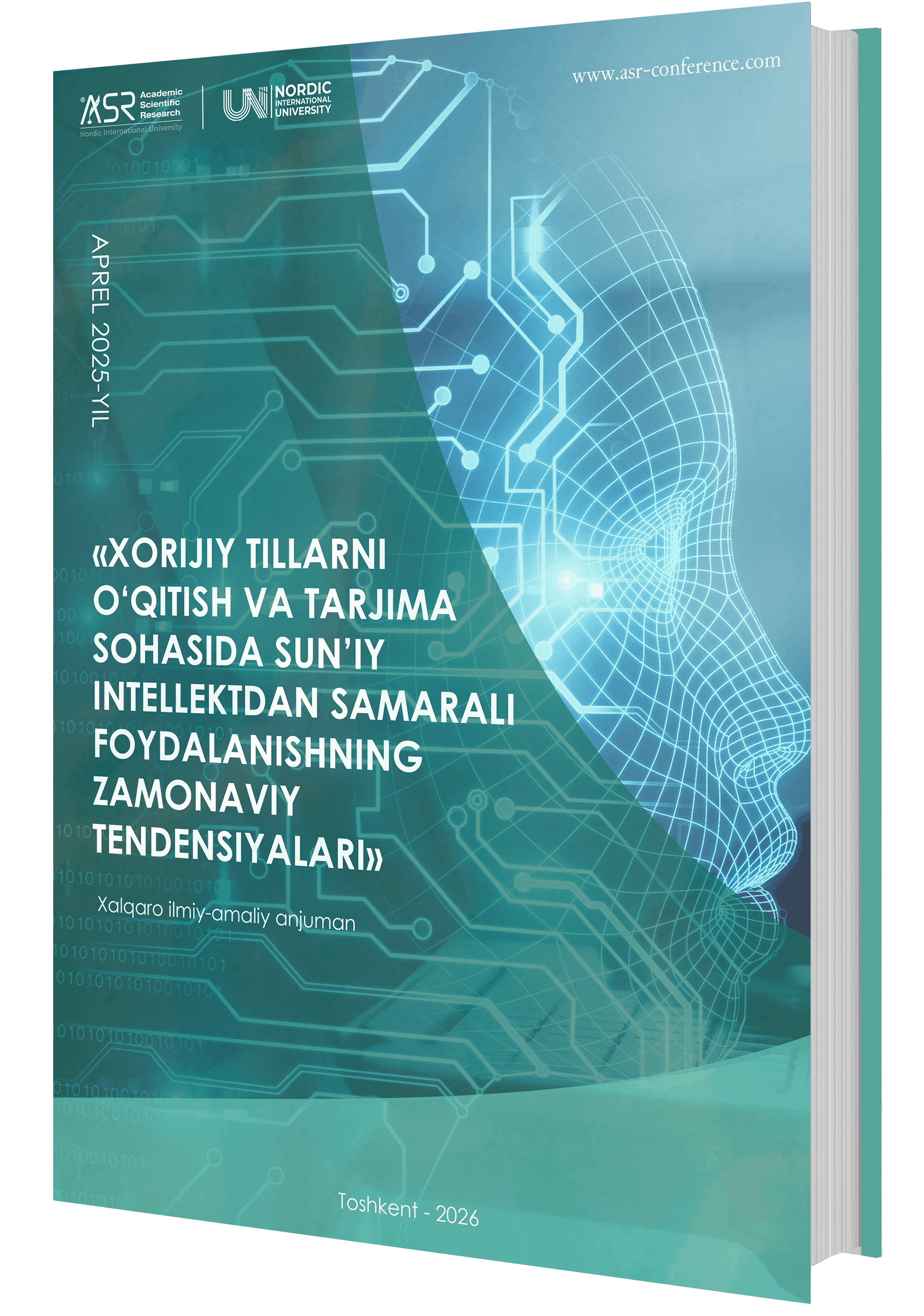
MODERN TRENDS IN THE EFFECTIVE USE OF ARTIFICIAL INTELLIGENCE IN FOREIGN LANGUAGE TEACHING AND TRANSLATION
Аннотация
The rapid advancement of artificial intelligence (AI) technologies has profoundly transformed the landscape of foreign language education and professional translation. This article examines current trends in the integration of AI tools — including large language models (LLMs), neural machine translation (NMT) systems, intelligent tutoring platforms, and automatic speech recognition (ASR) — into language learning environments and translation workflows. Drawing on recent empirical studies and technological developments, the paper argues that while AI significantly enhances personalization, efficiency, and accessibility in language education, its role in translation and interpreting practice remains supplementary rather than autonomous. The findings highlight the transformative potential of AI, the pedagogical challenges associated with its adoption, and the necessity of cultivating hybrid human-AI competencies among modern language professionals.
Библиографические ссылки
1. Godwin-Jones, R. (2022). Partnering with AI: Intelligent writing assistance and instructed language learning. Language Learning & Technology, 26(2), 5–24. https://doi.org/10.44862/llt.2022.v26n2a2
2. Luckin, R., & Cukurova, M. (2019). Designing educational technologies in the age of AI: A learning sciences-driven approach. British Journal of Educational Technology, 50(6), 2824–2838. https://doi.org/10.1111/bjet.12827
3. Johnson, A., & Smith, B. (2021). Adaptive learning systems in EFL classrooms: Personalization and outcomes. TESOL Quarterly, 55(4), 1123–1148. https://doi.org/10.1002/tesq.3021
4. Warschauer, M., Tseng, W., Yim, S., Webster, T., Jacob, S., Du, Q., & Tate, T. (2023). The affordances and contradictions of AI-generated text for writers of academic English as an additional language. Journal of Second Language Writing, 62, 101057. https://doi.org/10.1016/j.jslw.2023.101057
5. Bentivogli, L., Bisazza, A., Cettolo, M., & Federico, M. (2022). Neural versus phrase-based machine translation quality: A case study. Proceedings of the 2022 Conference on Empirical Methods in Natural Language Processing, 257–267.
6. Koehn, P., & Knowles, R. (2017). Six challenges for neural machine translation. Proceedings of the First Workshop on Neural Machine Translation, 28–39. https://doi.org/10.18653/v1/W17-3204
7. Chen, X., Zou, D., Cheng, G., & Xie, H. (2020). Detecting latent topics and trends in educational technologies over four decades using structural topic modeling: A retrospective study. British Journal of Educational Technology, 51(3), 692–708. https://doi.org/10.1111/bjet.12817
8. Wang, C. (2023). The effect of AI-powered pronunciation training on Chinese EFL learners: A longitudinal study. System, 112, 102965. https://doi.org/10.1016/j.system.2023.102965
9. Yamamoto, K., Sato, H., & Tanaka, M. (2022). Conversational AI and willingness to communicate in EFL contexts: Evidence from Japanese university students. Computer Assisted Language Learning, 35(9), 2195–2218. https://doi.org/10.1080/09588221.2022.2095893
10. Kim, S., & Park, J. (2023). Automated writing evaluation in South Korean EFL classrooms: Scaffold or crutch? Language Teaching Research, 27(4), 945–968. https://doi.org/10.1177/13621688211016765
11. Rodriguez, C., Morales, V., & Torres, A. (2023). Post-editing neural machine translation in professional translation workflows: Productivity and quality. Meta: Translators' Journal, 68(1), 112–134. https://doi.org/10.7202/1098254ar
12. Sandrelli, A. (2022). Technology in interpreter training: State of the art and future directions. The Interpreter and Translator Trainer, 16(3), 287–307. https://doi.org/10.1080/1750399X.2022.2086967
13. Berk, N., Fantinuoli, C., & Prandi, B. (2022). Automatic speech recognition for simultaneous interpreters: Current state and future challenges. Interpreting, 24(2), 218–248. https://doi.org/10.1075/intp.00072.ber
14. Risko, E. F., & Gilbert, S. J. (2016). Cognitive offloading. Trends in Cognitive Sciences, 20(9), 676–688. https://doi.org/10.1016/j.tics.2016.07.002
15. Perkins, M. (2023). Academic integrity considerations of AI large language models as writing assistants: A comparative case study across higher education contexts. Journal of Academic Ethics, 21, 317–334. https://doi.org/10.1007/s10805-023-09455-5
16. Joshi, P., Santy, S., Budhiraja, A., Bali, K., & Choudhury, M. (2020). The state and fate of linguistic diversity and inclusion in the NLP world. Proceedings of the 58th Annual Meeting of the ACL, 6282–6293. https://doi.org/10.18653/v1/2020.acl-main.560
Загрузки
Опубликован
Выпуск
Раздел
Лицензия
Copyright (c) 2026 U.N. Karimov , N.N. Kushieva

Это произведение доступно по лицензии Creative Commons «Attribution-NonCommercial» («Атрибуция — Некоммерческое использование») 4.0 Всемирная.
Условия лицензии
Эта работа доступна под лицензией Creative Commons Attribution-NonCommercial 4.0 International License. Чтобы просмотреть копию этой лицензии, посетите http://creativecommons.org/licenses/by-nc/4.0/ или отправьте письмо по адресу Creative Commons, PO Box 1866, Mountain View, CA 94042, США.
По этой лицензии вы можете:
Поделиться — копируйте и распространяйте материал на любом носителе и в любом формате.
Адаптируйте — делайте ремиксы, трансформируйте и дорабатывайте материал.
Лицензиар не может отозвать эти свободы, если вы соблюдаете условия лицензии. На следующих условиях:
Атрибуция. Вы должны указать соответствующую ссылку, предоставить ссылку на лицензию и указать, были ли внесены изменения. Вы можете сделать это любым разумным способом, но не таким образом, который бы предполагал, что лицензиар одобряет вас или ваше использование.
Некоммерческое использование — вы не имеете права использовать материал в коммерческих целях.
Никаких дополнительных ограничений. Вы не имеете права применять юридические условия или технологические меры, которые юридически запрещают другим делать все, что разрешено лицензией.